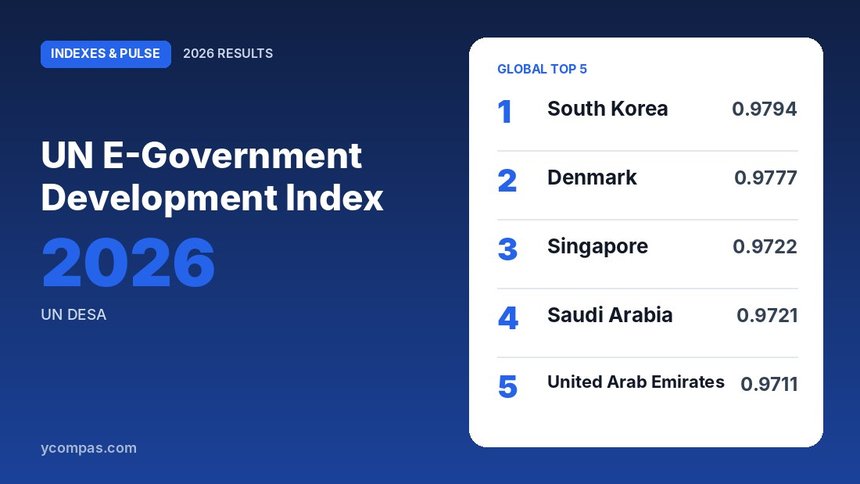
The United Nations Department of Economic and Social Affairs (UN DESA) released the 2026 UN E-Government Survey in November 2026. Its headline measure, the E-Government Development Index (EGDI), assesses digital government in the 193 UN Member States and, for the first time, the State of Palestine. The ranking at the top has been reshuffled — and two Gulf countries now sit among the world’s five leaders.
Key facts
- South Korea ranks first (0.9794), up from 4th in 2024, ahead of Denmark (1st in 2024) and Singapore, which holds 3rd place.
- Saudi Arabia climbs from 6th to 4th, and the United Arab Emirates jumps from 11th to 5th. Saudi authorities report that the Kingdom also ranks first worldwide on the Online Service Index.
- Digital government keeps improving: the average EGDI rises to about 0.67, from about 0.64 in 2024, and 84 countries now reach the very high level (0.75 or more).
- Africa’s best performer, South Africa, ranks 52nd (40th in 2024): no African country is in the top 50. Rwanda (104th, from 118th) and Zambia (99th, from 130th) are among the biggest risers on the continent.
- In 2026 a new Participation and Engagement subindex replaces the former E-Participation Index; UN DESA advises caution when comparing it with earlier editions.
Global top 4
| Rank | Country | EGDI | Change |
|---|---|---|---|
| 1 | South Korea | 0.9794 | ▲ 3 |
| 2 | Denmark | 0.9777 | ▼ 1 |
| 3 | Singapore | 0.9722 | = |
| 4 | Saudi Arabia | 0.9721 | ▲ 2 |
Top 5 in Africa
| # | Country | Global rank | EGDI |
|---|---|---|---|
| 1 | South Africa | 52 | 0.8379 |
| 2 | Morocco | 89 | 0.7350 |
| 3 | Mauritius | 92 | 0.7226 |
| 4 | Tunisia | 96 | 0.7086 |
| 5 | Zambia | 99 | 0.6853 |
Top 5 in the Arab world
| # | Country | Global rank | EGDI |
|---|---|---|---|
| 1 | Saudi Arabia | 4 | 0.9721 |
| 2 | United Arab Emirates | 5 | 0.9711 |
| 3 | Bahrain | 14 | 0.9420 |
| 4 | Oman | 33 | 0.8875 |
| 5 | Qatar | 60 | 0.8051 |
Change: positions gained (▲) or lost (▼) since the previous edition.
Our take
The Gulf story is the standout of this edition. All six GCC countries sit in the very high group, and their average EGDI (0.89) is far above the world average (0.67). Saudi Arabia and the UAE show that a sustained, centrally driven programme — with measures such as unified service portals, digital identity and mobile-first services — can move a country into the global top five within a few survey cycles. Bahrain (14th) and Oman (33rd, from 41st) are also moving up.
North Africa presents a more mixed picture. Morocco is stable (89th), but Tunisia (96th, from 87th) and Egypt (109th, from 95th) lose ground. With the global average rising, countries that stand still slip down the ranking. For governments across Africa and the Arab region, the subindex profile matters more than the rank: telecommunications infrastructure and human capital often hold scores back as much as online services. The new Participation and Engagement subindex is also a reminder that digital government is now judged on how it involves citizens, not only on the services it offers.
How the index works
The EGDI is the average of three normalised components: the Online Service Index (assessed by UN researchers), the Telecommunication Infrastructure Index (ITU data) and the Human Capital Index (UNESCO data). Scores range from 0 to 1.
Find out more
- Official source: UN E-Government Development Index — UN DESA
- Explore all scores and trends on YCompas WorldIndex: UN E-Government Development Index
- Background: The UN E-Government Development Index: Benchmarking Digital Government Worldwide