The 2026 UN E-Government Survey shows digital government improving worldwide: the average EGDI rises to about 0.67, from about 0.64 in 2024, and 84 countries now reach the very high level. But some countries are moving much faster than others.
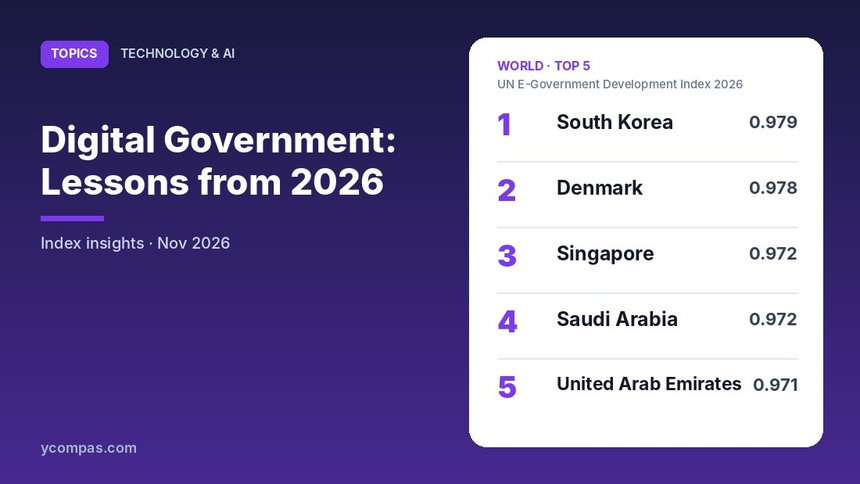
World top 10: UN E-Government Development Index 2026
| Rank | Country | EGDI | Change |
|---|---|---|---|
| 1 | South Korea | 0.9794 | ▲ 3 |
| 2 | Denmark | 0.9777 | ▼ 1 |
| 3 | Singapore | 0.9722 | = |
| 4 | Saudi Arabia | 0.9721 | ▲ 2 |
| 5 | United Arab Emirates | 0.9711 | ▲ 6 |
| 6 | Iceland | 0.9557 | ▼ 1 |
| 7 | United Kingdom | 0.9553 | = |
| 8 | Estonia | 0.9542 | ▼ 6 |
| 9 | Finland | 0.9534 | = |
| 10 | Australia | 0.9513 | ▼ 2 |
Change: places gained (▲) or lost (▼) since the previous edition.
Who moved most
Among the risers: the UAE (from 11th to 5th), Saudi Arabia (6th to 4th), Oman (41st to 33rd), Zambia (130th to 99th) and Rwanda (118th to 104th). Among those losing ground: South Africa (40th to 52nd), Egypt (95th to 109th), Tunisia (87th to 96th), Kuwait (66th to 82nd) and Qatar (53rd to 60th).
Five lessons
1. Treat digital government as a whole-of-government programme. The leaders coordinate digital transformation from the centre of government, with clear mandates, shared platforms and common standards.
2. Build the shared foundations first. Digital identity, interoperability, data sharing and cloud infrastructure make every new service faster and cheaper to deliver.
3. Design around life events, not ministries. Citizens think in terms of having a child, starting a business or retiring, not of agencies. Integrated, proactive services are what move the Online Service Index.
4. Don’t neglect infrastructure and skills. Two thirds of the EGDI depend on telecommunications infrastructure and human capital. Online services alone cannot lift a country’s score.
5. Measure, publish and involve citizens. The new Participation and Engagement subindex rewards governments that consult citizens, publish data and show how input shapes decisions.
Our take
Digital government rankings reward consistency. Countries that stand still slip, because the global baseline keeps rising. The most effective strategy is to link the EGDI’s components to a national roadmap, with clear owners and measurable targets — and to use enterprise architecture to keep the whole programme coherent.