The V-Dem Institute at the University of Gothenburg has released its 2026 dataset (version 16), covering 1789 to 2025. Its flagship Liberal Democracy Index (LDI) captures free and fair elections together with individual liberties and checks on executive power.
Key facts
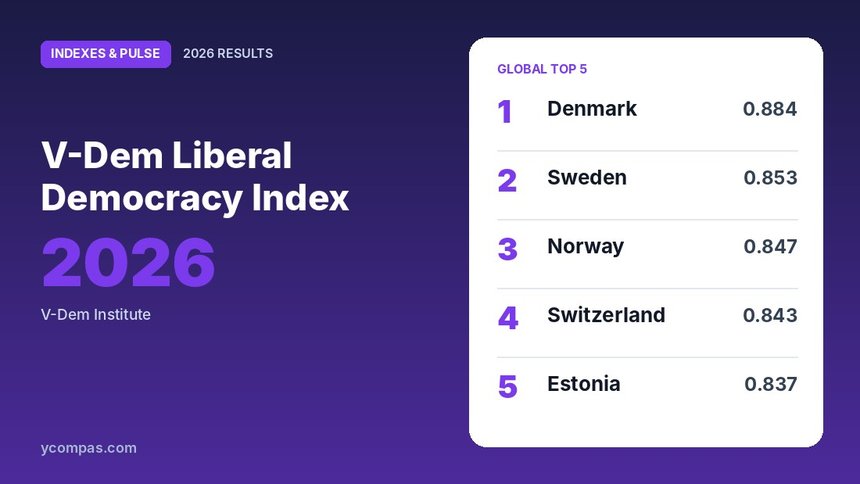
- Denmark has the highest LDI (0.88), followed by Sweden and Norway (0.85), and Switzerland and Estonia (0.84).
- Eritrea, North Korea, Myanmar, Afghanistan and Nicaragua have the lowest scores, all below 0.02.
- Of the 176 countries on YCompas WorldIndex, 31 are liberal democracies, 56 electoral democracies, 55 electoral autocracies and 34 closed autocracies.
- Seychelles (31st) leads Africa, ahead of Mauritius, South Africa, Cape Verde and Ghana. In the Arab world, the highest scores are in Jordan, Lebanon and Tunisia, all ranked around 100th.
Global top 4
| Rank | Country | LDI | Change |
|---|---|---|---|
| 1 | Denmark | 0.884 | = |
| 2 | Sweden | 0.853 | ▲ 2 |
| 3 | Norway | 0.847 | = |
| 4 | Switzerland | 0.843 | ▲ 1 |
Top 5 in Africa
| # | Country | Global rank | LDI |
|---|---|---|---|
| 1 | Seychelles | 31 | 0.680 |
| 2 | Mauritius | 38 | 0.639 |
| 3 | South Africa | 39 | 0.633 |
| 4 | Cape Verde | 40 | 0.631 |
| 5 | Ghana | 45 | 0.606 |
Top 5 in the Arab world
| # | Country | Global rank | LDI |
|---|---|---|---|
| 1 | Jordan | 101 | 0.274 |
| 2 | Lebanon | 102 | 0.267 |
| 3 | Tunisia | 103 | 0.265 |
| 4 | Morocco | 105 | 0.251 |
| 5 | Iraq | 109 | 0.220 |
Change: positions gained (▲) or lost (▼) since the previous edition.
Our take
Autocracies — electoral and closed — now outnumber democracies, and only 31 countries meet V-Dem’s criteria for liberal democracy. The decline is driven less by coups than by gradual erosion: pressure on the media, civil society and courts by elected governments.
Africa hosts some of the world’s most resilient democracies, from Seychelles and Mauritius to Cape Verde, South Africa and Ghana. The Arab world scores far lower, with an average LDI of 0.13 against 0.38 worldwide; all six GCC countries are classified as closed autocracies. Tunisia, once the region’s democratic exception, has seen its LDI fall from 0.63 in 2019 (42nd) to 0.27 in 2025 (103rd).
How the index works
Thousands of country experts rate hundreds of indicators, combined with a Bayesian measurement model. The LDI combines the electoral component (free elections, freedoms of expression and association) with the liberal component (equality before the law, judicial and legislative constraints on the executive), on a 0–1 scale.
Find out more
- Official source: V-Dem Liberal Democracy Index — V-Dem Institute
- Explore all scores and trends on YCompas WorldIndex: V-Dem Liberal Democracy Index
- Background: V-Dem’s Liberal Democracy Index: Measuring Democracy in All Its Varieties