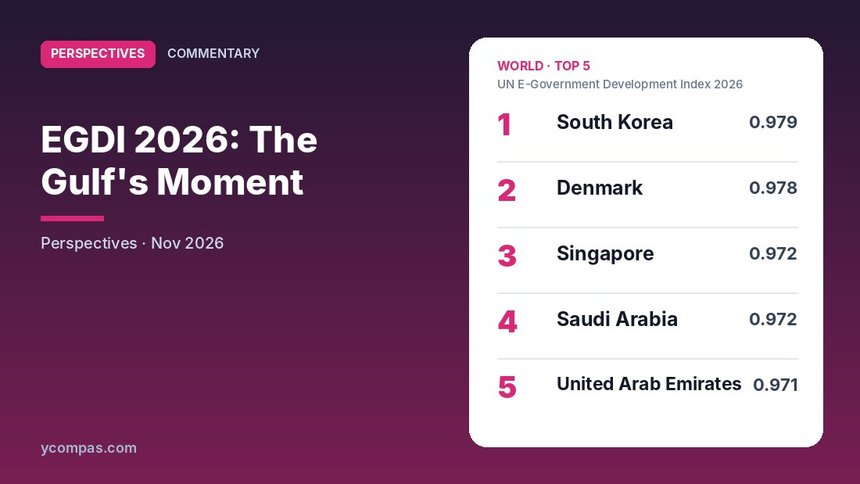
The 2026 UN E-Government Survey will be remembered in the Gulf. Saudi Arabia moves to 4th place in the E-Government Development Index and the United Arab Emirates to 5th, joining South Korea, Denmark and Singapore among the global leaders. Bahrain (14th) and Oman (33rd) also advance.
World top 10: UN E-Government Development Index 2026
| Rank | Country | EGDI | Change |
|---|---|---|---|
| 1 | South Korea | 0.9794 | ▲ 3 |
| 2 | Denmark | 0.9777 | ▼ 1 |
| 3 | Singapore | 0.9722 | = |
| 4 | Saudi Arabia | 0.9721 | ▲ 2 |
| 5 | United Arab Emirates | 0.9711 | ▲ 6 |
| 6 | Iceland | 0.9557 | ▼ 1 |
| 7 | United Kingdom | 0.9553 | = |
| 8 | Estonia | 0.9542 | ▼ 6 |
| 9 | Finland | 0.9534 | = |
| 10 | Australia | 0.9513 | ▼ 2 |
Change: places gained (▲) or lost (▼) since the previous edition.
What explains the rise
The Gulf’s progress did not happen by chance. It reflects a decade of centrally coordinated programmes, national digital identity, unified service platforms, aggressive investment in connectivity and a clear political mandate. Saudi authorities report first place worldwide on the Online Service Index. Both have consistently treated digital government as a whole-of-government transformation, not an IT project.
What the ranking does not yet show
Three questions will decide whether the Gulf’s lead is durable.
First, participation. The Survey’s new Participation and Engagement subindex measures how governments involve citizens in decisions. Leading on services is not the same as leading on participation.
Second, AI readiness. The next generation of digital government will be proactive and AI-enabled. That requires data governance, interoperability, skills and responsible-AI frameworks — areas where the Gulf is investing but where global standards are still forming.
Third, consistency across the region. Qatar (60th) and Kuwait (82nd) lose ground in 2026. In a rising global baseline, standing still means falling behind.
Top 10 in the Arab world: UN E-Government Development Index 2026
| # | Country | Global rank | EGDI | Change |
|---|---|---|---|---|
| 1 | Saudi Arabia | 4 | 0.9721 | ▲ 2 |
| 2 | United Arab Emirates | 5 | 0.9711 | ▲ 6 |
| 3 | Bahrain | 14 | 0.9420 | ▲ 4 |
| 4 | Oman | 33 | 0.8875 | ▲ 8 |
| 5 | Qatar | 60 | 0.8051 | ▼ 7 |
| 6 | Kuwait | 82 | 0.7572 | ▼ 16 |
| 7 | Morocco | 89 | 0.7350 | ▲ 1 |
| 8 | Jordan | 94 | 0.7177 | ▼ 5 |
| 9 | Tunisia | 96 | 0.7086 | ▼ 9 |
| 10 | Egypt | 109 | 0.6584 | ▼ 14 |
Change: places gained (▲) or lost (▼) since the previous edition.
Our view
The 2026 results are a well-deserved recognition for the teams who built the Gulf’s digital governments. The opportunity now is to turn leadership in digital services into leadership in digital governance — trustworthy AI, open data and meaningful engagement — and to share what has worked with the rest of the Arab world and Africa.