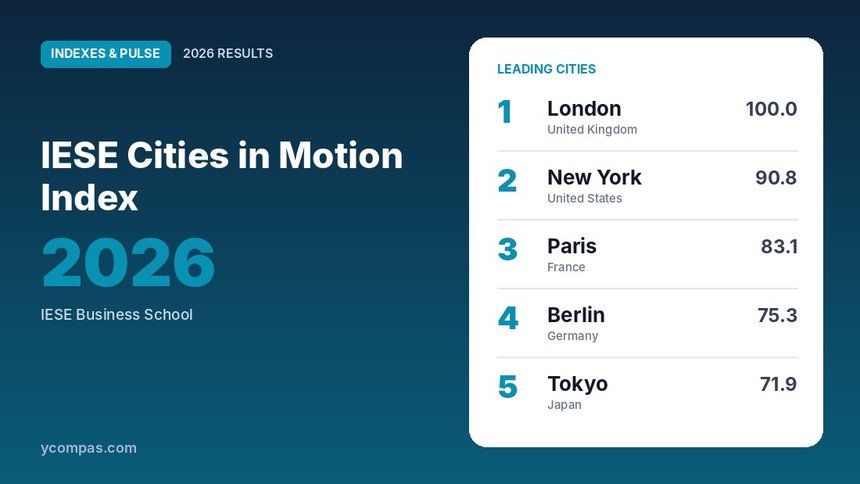
IESE Business School (University of Navarra) has published the 2026 Cities in Motion Index (CIMI), its 11th edition. It assesses 183 cities in 92 countries on 115 indicators across nine dimensions of sustainable, inclusive and competitive urban development.
Key facts
- London remains the world’s top city, followed by New York and Paris.
- Dubai is the best-placed city in the Arab world (25th of 183 cities), followed by Doha, Riyadh (128th), Manama and Amman.
- Cape Town (148th) is Africa’s best-placed city, ahead of Tunis (160th), Rabat, Accra and Cairo (173rd).
- On YCompas WorldIndex, each country is represented by its highest-ranked city; the tables show both the country position and the city’s rank among the 183 cities.
Global top 4
| Rank | Country | City | City rank | Score | Change |
|---|---|---|---|---|---|
| 1 | United Kingdom | London | 1 | 100.0 | = |
| 2 | United States | New York | 2 | 90.8 | = |
| 3 | France | Paris | 3 | 83.1 | = |
| 4 | Germany | Berlin | 4 | 75.3 | ▲ 1 |
Top 5 in Africa
| # | Country | City | City rank | Global rank | Score |
|---|---|---|---|---|---|
| 1 | South Africa | Cape Town | 148 | 65 | 30.4 |
| 2 | Tunisia | Tunis | 160 | 71 | 25.9 |
| 3 | Morocco | Rabat | 161 | 72 | 25.5 |
| 4 | Ghana | Accra | 170 | 78 | 21.6 |
| 5 | Egypt | Cairo | 173 | 80 | 20.9 |
Top 5 in the Arab world
| # | Country | City | City rank | Global rank | Score |
|---|---|---|---|---|---|
| 1 | United Arab Emirates | Dubai | 25 | 17 | 62.8 |
| 2 | Qatar | Doha | 122 | 50 | 39.2 |
| 3 | Saudi Arabia | Riyadh | 128 | 54 | 37.2 |
| 4 | Bahrain | Manama | 139 | 59 | 33.6 |
| 5 | Jordan | Amman | 152 | 67 | 29.1 |
Change: positions gained (▲) or lost (▼) since the previous edition.
Our take
The CIMI’s broad definition of a successful city — economy, human capital, governance, environment, mobility and more — rewards global hubs that combine economic weight with international reach. The economy dimension carries the highest weight in 2026, which helps explain the dominance of large Western capitals.
Gulf cities continue to climb: the UAE, Qatar, Saudi Arabia and Bahrain all gain places this year through Dubai, Doha, Riyadh and Manama. African cities remain in the bottom third, but Cape Town, Tunis and Rabat improve. For city leaders in Africa and the Arab region, the dimension profiles — notably mobility, environment and social cohesion — point to where investment can raise quality of life fastest.
How the index works
The index combines 115 indicators across nine dimensions (economy, human capital, social cohesion, governance, environment, mobility, urban planning, international profile, technology) using the DP2 distance method, on a scale where the top city scores 100.
Find out more
- Official source: IESE Cities in Motion Index — IESE Business School
- Explore all scores and trends on YCompas WorldIndex: IESE Cities in Motion Index
- Background: IESE Cities in Motion Index: Ranking the World’s Most Livable and Smart Cities