Transparency International released the Corruption Perceptions Index (CPI) 2025 on 10 February 2026. It ranks 182 countries and territories by perceived levels of public-sector corruption on a scale from 0 (highly corrupt) to 100 (very clean).
Key facts
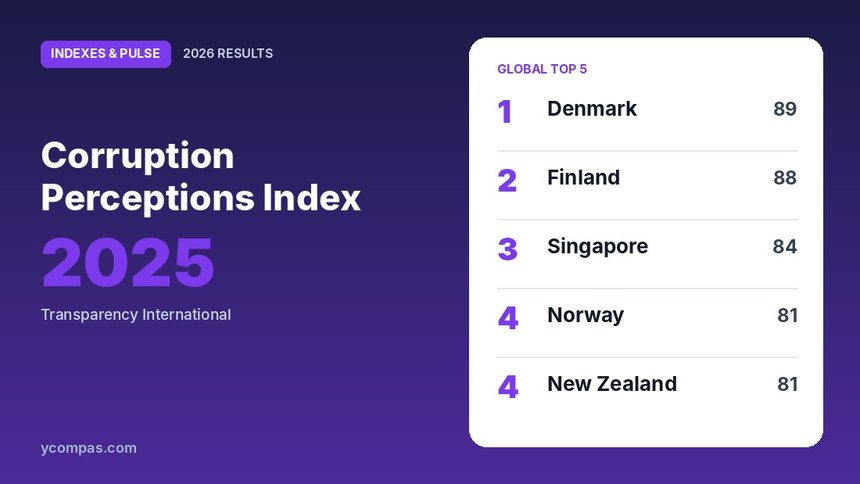
- Denmark (89) tops the index for the 8th consecutive year, followed by Finland (88) and Singapore (84); Norway and New Zealand share 4th place (81).
- The global average is 42, and more than two thirds of countries score below 50.
- Since 2012, 31 countries have improved significantly while 50 have declined significantly.
- Seychelles (68) leads Africa despite losing six places, ahead of Cape Verde, Botswana and Rwanda. The United Arab Emirates (69) leads the Arab world, ahead of Qatar and Saudi Arabia.
- South Sudan and Somalia (9) and Venezuela (10) are at the bottom.
Global top 4
| Rank | Country | Score | Change |
|---|---|---|---|
| 1 | Denmark | 89 | = |
| 2 | Finland | 88 | = |
| 3 | Singapore | 84 | = |
| 4 | Norway | 81 | ▲ 1 |
| 4 | New Zealand | 81 | = |
Top 5 in Africa
| # | Country | Global rank | Score |
|---|---|---|---|
| 1 | Seychelles | 24 | 68 |
| 2 | Cape Verde | 35 | 62 |
| 3 | Botswana | 41 | 58 |
| 4 | Rwanda | 41 | 58 |
| 5 | Mauritius | 61 | 48 |
Top 5 in the Arab world
| # | Country | Global rank | Score |
|---|---|---|---|
| 1 | United Arab Emirates | 21 | 69 |
| 2 | Qatar | 41 | 58 |
| 3 | Saudi Arabia | 45 | 57 |
| 4 | Oman | 54 | 52 |
| 5 | Bahrain | 56 | 50 |
Change: positions gained (▲) or lost (▼) since the previous edition.
Our take
The CPI’s long-term picture is sobering: far more countries have declined than improved since 2012. Corruption thrives where checks and balances, independent media and civil society are weak — which is why the CPI correlates so closely with democracy and rule-of-law indicators.
The Gulf performs well above the regional average, with the UAE 21st and Qatar 41st, but several GCC countries lose ground this year (Saudi Arabia down seven places). In Africa, Seychelles, Cape Verde, Botswana and Rwanda show that clean governance is achievable at very different income levels. Tunisia (91st, score 39) remains in the bottom half.
How the index works
The CPI aggregates 13 independent data sources — expert assessments and business surveys — on perceptions of public-sector corruption. A country needs at least three sources to be included.
Find out more
- Official source: Corruption Perceptions Index — Transparency International
- Explore all scores and trends on YCompas WorldIndex: Corruption Perceptions Index
- Background: The Corruption Perceptions Index: How Transparency International Measures Corruption