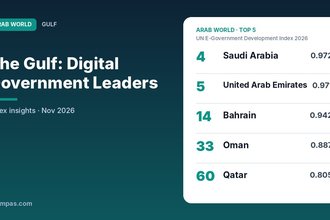
Digital government is the Gulf’s headline success of 2026. But how do the six GCC countries perform across the wider set of global indexes? The answer is a region of contrasts: world-class competitiveness and wellbeing, weaker results on sustainability, and low scores on civic and political freedoms.
Competitiveness and innovation
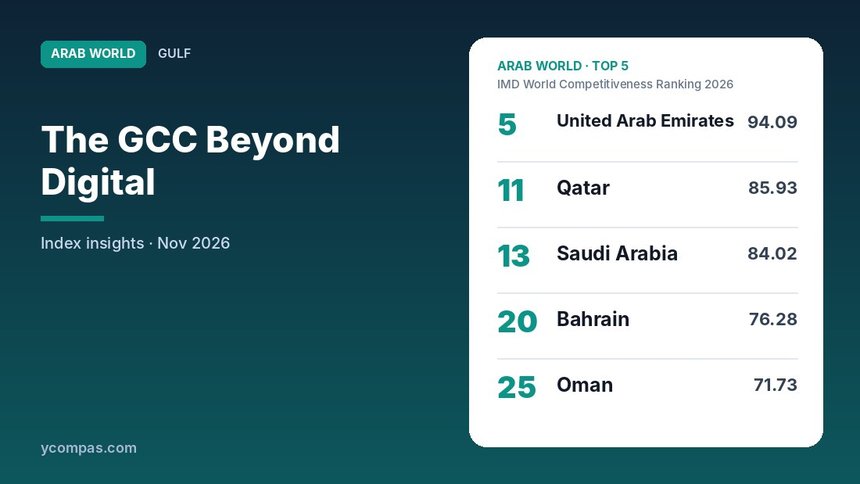
In the 2026 IMD World Competitiveness Ranking, the UAE is 5th of 70 economies, Qatar 11th, Saudi Arabia 13th (up four places), Bahrain 20th and Oman 25th. In the Global Innovation Index, the UAE (25th), Saudi Arabia (42nd) and Qatar (47th) lead the Arab region.
Top 10 in the Arab world: IMD World Competitiveness Ranking 2026
| # | Country | Global rank | Score | Change |
|---|---|---|---|---|
| 1 | United Arab Emirates | 5 | 94.09 | = |
| 2 | Qatar | 11 | 85.93 | ▼ 2 |
| 3 | Saudi Arabia | 13 | 84.02 | ▲ 4 |
| 4 | Bahrain | 20 | 76.28 | ▲ 2 |
| 5 | Oman | 25 | 71.73 | ▲ 3 |
| 6 | Kuwait | 31 | 70.13 | ▲ 5 |
| 7 | Jordan | 46 | 59.28 | ▲ 1 |
Only 7 Arab countries are covered in this edition. Change: places gained (▲) or lost (▼) since the previous edition.
Wellbeing and peace
The UAE (21st) and Saudi Arabia (22nd) are the happiest Arab countries in the World Happiness Report 2026, ahead of several European countries. The 2026 Global Peace Index, however, records sharp falls for Qatar (31st, down ten places), Kuwait (49th, down 13) and Oman (60th, down 26) — a reflection of rising regional tensions.
Top 10 in the Arab world: World Happiness Report 2026
| # | Country | Global rank | Score |
|---|---|---|---|
| 1 | United Arab Emirates | 21 | 6.82 |
| 2 | Saudi Arabia | 22 | 6.82 |
| 3 | Kuwait | 40 | 6.54 |
| 4 | Bahrain | 55 | 6.25 |
| 5 | Oman | 58 | 6.20 |
| 6 | Libya | 81 | 5.73 |
| 7 | Algeria | 83 | 5.71 |
| 8 | Iraq | 95 | 5.21 |
| 9 | Tunisia | 105 | 4.80 |
| 10 | Palestine | 109 | 4.69 |
Sustainability: the weakest dimension
In the Climate Change Performance Index 2027, the UAE (64th) and Saudi Arabia (65th) rank near the bottom of the 64 countries and the EU assessed. The Environmental Performance Index is more nuanced: the UAE (42nd) and Oman (49th) lead the Arab world. In the SDG Index, the UAE (71st) and Oman (81st) score best, while Qatar, Saudi Arabia, Bahrain and Kuwait rank between 101st and 120th.
Freedoms
In V-Dem’s 2026 data, all six GCC countries are classified as closed autocracies, and most rank low in the World Press Freedom Index — with the exception of Qatar (75th).
Scorecard: 2026 positions
| Country | IMD Compet. 2026 /70 | Innovation (GII) 2026 /139 | Happiness 2026 /147 | Peace (GPI) 2026 /163 | SDG Index 2026 /169 |
|---|---|---|---|---|---|
| United Arab Emirates | 5 | 25 | 21 | 73 | 71 |
| Saudi Arabia | 13 | 42 | 22 | 95 | 104 |
| Qatar | 11 | 47 | – | 31 | 101 |
| Kuwait | 31 | 62 | 40 | 49 | 120 |
| Bahrain | 20 | 64 | 55 | 108 | 105 |
| Oman | 25 | 69 | 58 | 60 | 81 |
Figures are global ranks (1 = best) unless marked “score”.
Our take
The GCC’s 2026 profile reflects deliberate choices: heavy investment in infrastructure, government efficiency and quality of life, delivered through strong central coordination. To sustain their momentum, Gulf economies will increasingly be judged on how fast they decarbonise and how they broaden participation — areas where global indexes still place them well behind their economic peers.