The Yale Center for Environmental Law & Policy has published the 2026 Environmental Performance Index (EPI). It ranks 177 countries on 47 indicators across 12 issue categories and three policy objectives, measuring how close countries are to established environmental targets.
Key facts
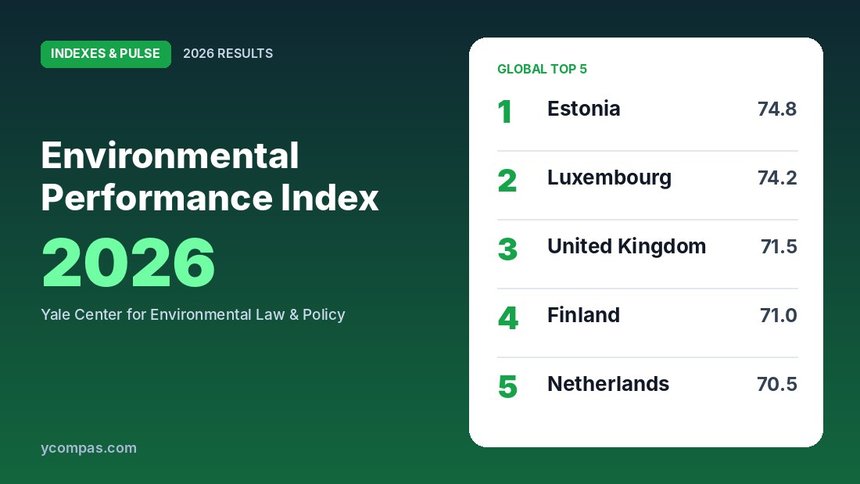
- Estonia leads the world (74.8), propelled by the dramatic greenhouse gas reductions that followed the closure of its oil shale power plants. Luxembourg, the United Kingdom, Finland and the Netherlands complete the top five.
- Laos finishes last; India (176th), Bangladesh, Mali and Vietnam complete the bottom five.
- Outside Europe, Japan ranks 16th, Australia 25th and the United States 27th; South Africa is 111th and China 129th.
- Botswana (38th) leads Africa, ahead of Seychelles, Gabon, Zimbabwe and Namibia. The United Arab Emirates (42nd) leads the Arab world, ahead of Oman, Jordan, Qatar and Algeria.
- Wealth strongly predicts environmental performance, partly because high-income countries can invest more in environmental infrastructure.
Global top 4
| Rank | Country | Score |
|---|---|---|
| 1 | Estonia | 74.8 |
| 2 | Luxembourg | 74.2 |
| 3 | United Kingdom | 71.5 |
| 4 | Finland | 71.0 |
Top 5 in Africa
| # | Country | Global rank | Score |
|---|---|---|---|
| 1 | Botswana | 38 | 51.8 |
| 2 | Seychelles | 43 | 50.0 |
| 3 | Gabon | 47 | 48.8 |
| 4 | Zimbabwe | 59 | 46.1 |
| 5 | Namibia | 77 | 42.8 |
Top 5 in the Arab world
| # | Country | Global rank | Score |
|---|---|---|---|
| 1 | United Arab Emirates | 42 | 50.2 |
| 2 | Oman | 49 | 48.5 |
| 3 | Jordan | 54 | 46.7 |
| 4 | Qatar | 67 | 45.1 |
| 5 | Algeria | 78 | 42.7 |
Our take
Estonia’s lead is the clearest illustration of how a single structural decision — phasing out the most carbon-intensive power source — can transform environmental performance. In the 2026 framework, climate change mitigation counts for 30% of the score, which rewards countries that are actually cutting emissions.
Africa’s leaders — Botswana, Seychelles and Gabon — perform well on ecosystem vitality, the objective with the largest weight. In the Arab world, the UAE and Oman lead, while Tunisia ranks 85th. Because the framework changed substantially since 2024, ranks are not directly comparable with the previous edition.
How the index works
The EPI combines 47 indicators in 12 issue categories under three objectives — ecosystem vitality (45%), climate change (30%) and environmental health (25%) — scored 0–100 against policy targets.
Find out more
- Official source: Environmental Performance Index — Yale Center for Environmental Law & Policy
- Explore all scores and trends on YCompas WorldIndex: Environmental Performance Index
- Background: The Environmental Performance Index: Yale’s Scorecard for Environmental Health and Ecosystems