Seen through the 2026 global indexes, the Arab world is less a single region than a spectrum. At one end, Gulf states compete with the world’s most advanced economies; at the other, countries affected by conflict rank among the lowest on almost every measure. In between, North African and Levant countries combine solid human development with weaker governance and freedoms.
The leaders in each index
The table below shows the best-ranked Arab country in each 2026 index on YCompas WorldIndex.
Arab leaders in each 2026 index
| Index | Edition | Best-ranked Arab country | Global rank | Score |
|---|---|---|---|---|
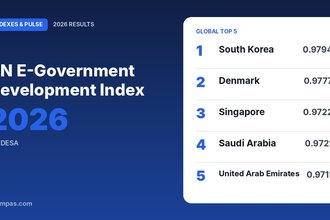
| UN E-Government Development Index | 2026 | Saudi Arabia | 4 | 0.9721 |
| ICT Development Index | 2026 | Saudi Arabia | – | 99.8 |
| IMD World Digital and AI Ranking | 2026 | United Arab Emirates | 15 | 91.13 |
| IMD World Competitiveness Ranking | 2026 | United Arab Emirates | 5 | 94.09 |
| Global Innovation Index | 2026 | United Arab Emirates | 25 | 46.4 |
| Index of Economic Freedom | 2026 | United Arab Emirates | 23 | 71.9 |
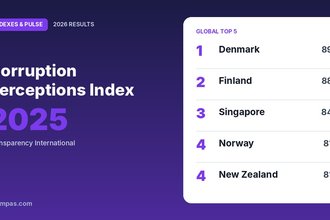
| Corruption Perceptions Index | 2025 | United Arab Emirates | 21 | 69 |
| WJP Rule of Law Index | 2026 | United Arab Emirates | 36 | 0.64 |
| V-Dem Liberal Democracy Index | 2026 | Jordan | 101 | 0.274 |
| World Press Freedom Index | 2026 | Mauritania | 61 | 63.36 |
| Freedom on the Net | 2026 | Jordan | 24 | 44 |
| Global Peace Index | 2026 | Qatar | 31 | 1.676 |
| World Happiness Report | 2026 | United Arab Emirates | 21 | 6.82 |
| Legatum Prosperity Index | 2026 | Kuwait | 50 | 71.7 |
| Global Multidimensional Poverty Index | 2026 | Palestine | 10 | 0.0020 |
| SDG Index | 2026 | Morocco | 68 | 71.7 |
| Environmental Performance Index | 2026 | United Arab Emirates | 42 | 50.2 |
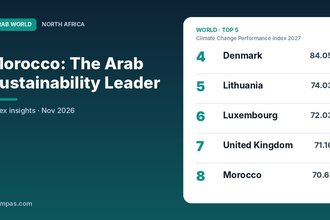
| Climate Change Performance Index | 2027 | Morocco | 8 | 70.61 |
| ND-GAIN Country Index | 2026 | United Arab Emirates | 56 | 53.7 |
| EF English Proficiency Index | 2026 | Morocco | 60 | 492 |
| Digital Quality of Life Index | 2026 | United Arab Emirates | 37 | 62.0 |
| IESE Cities in Motion Index | 2026 | United Arab Emirates (Dubai) | 25 (city) | 62.82 |
| IMD Smart City Index | 2026 | United Arab Emirates (Dubai) | 6 (city) | A |
The Global Terrorism Index is not shown, as many countries share the best possible score (no impact). The ICT Development Index publishes scores only.
The UAE leads the Arab world in a majority of indexes — from competitiveness and innovation to corruption perceptions and the rule of law. Saudi Arabia leads in digital government and connectivity, Morocco in climate performance, the SDGs and English proficiency, Jordan in democracy and internet freedom, Mauritania in press freedom, Qatar in peace, Kuwait in prosperity and Palestine in low multidimensional poverty.
The gaps behind the averages
- Digital government: six GCC countries average about 0.89 in the 2026 EGDI, against a world average of 0.67.
- Democracy: the Arab world’s average Liberal Democracy Index is 0.13, against 0.38 worldwide, and no Arab country is in the top 100.
- Press freedom: no Arab country ranks in the top 50 of the World Press Freedom Index, and the regional average score (39) is well below Africa’s (52).
- Conflict: Syria, Somalia, Iraq, Palestine and Yemen remain the Arab countries most affected by terrorism.
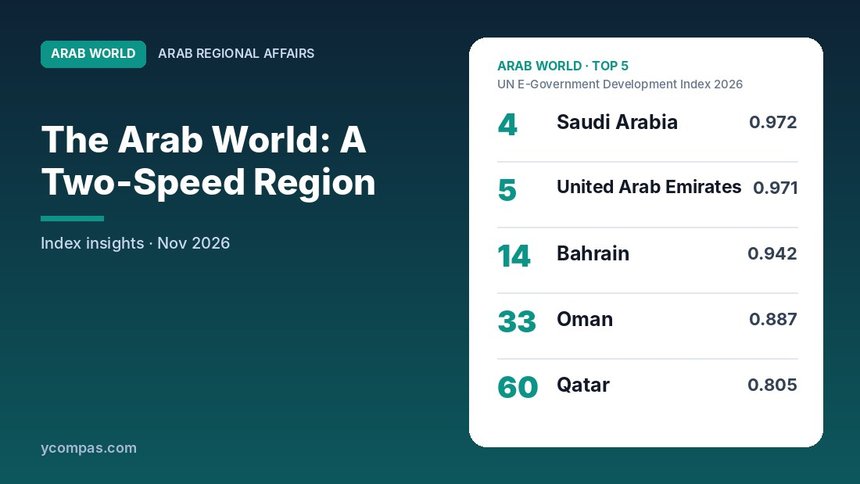
Top 10 in the Arab world: UN E-Government Development Index 2026
| # | Country | Global rank | EGDI | Change |
|---|---|---|---|---|
| 1 | Saudi Arabia | 4 | 0.9721 | ▲ 2 |
| 2 | United Arab Emirates | 5 | 0.9711 | ▲ 6 |
| 3 | Bahrain | 14 | 0.9420 | ▲ 4 |
| 4 | Oman | 33 | 0.8875 | ▲ 8 |
| 5 | Qatar | 60 | 0.8051 | ▼ 7 |
| 6 | Kuwait | 82 | 0.7572 | ▼ 16 |
| 7 | Morocco | 89 | 0.7350 | ▲ 1 |
| 8 | Jordan | 94 | 0.7177 | ▼ 5 |
| 9 | Tunisia | 96 | 0.7086 | ▼ 9 |
| 10 | Egypt | 109 | 0.6584 | ▼ 14 |
Change: places gained (▲) or lost (▼) since the previous edition.
Our take
The Arab world’s two speeds are not fixed. Several countries have moved quickly when strategy, investment and institutional capacity aligned — the Gulf’s digital rise is the clearest example. The 2026 data suggest that the region’s next gains will come from extending that model beyond technology: to governance, participation, sustainability and regional cooperation.