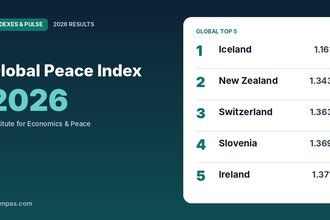
Peace is usually defined by what is absent: war. The Global Peace Index (GPI), produced by the Institute for Economics & Peace (IEP), takes a broader view, measuring both external conflict and the level of safety and security within societies. It ranks 163 independent states and territories, covering almost the entire world population.
Origins and ownership
The Institute for Economics & Peace is an independent, non-partisan think tank founded by the Australian entrepreneur Steve Killelea, with offices in Sydney and several other cities. The first GPI was published in 2007. The index is produced with the support of an international expert panel, and much of its data comes from the Economist Intelligence Unit and international organisations.
How it is measured
The GPI uses 23 qualitative and quantitative indicators, grouped into three domains:
- Ongoing domestic and international conflict — the number and intensity of conflicts, deaths from conflict, and relations with neighbouring countries.
- Societal safety and security — perceptions of criminality, homicide and incarceration rates, political instability, terrorism impact, violent demonstrations and refugees and displaced people.
- Militarisation — military expenditure, armed services personnel, weapons imports and exports, nuclear and heavy weapons capabilities and contributions to UN peacekeeping.
Each indicator is scored from 1 to 5 and weighted to produce the overall score.
Reading the results
A lower score means a more peaceful country. Iceland has ranked as the most peaceful country every year since 2008. The domain scores are essential: some countries are internally very safe but highly militarised, while others have small militaries but high levels of crime and unrest. IEP also estimates the economic cost of violence, which runs into trillions of dollars a year worldwide.
Why it matters
The GPI shows that peace can be measured and that it has a clear economic value. Alongside the index, IEP’s research on Positive Peace — the attitudes, institutions and structures that sustain peaceful societies — gives governments a framework for building resilience rather than only reacting to violence.
Find out more
- Official source: Vision of Humanity — Global Peace Index
- Explore country scores on YCompas WorldIndex: Global Peace Index